Every org, any tenant
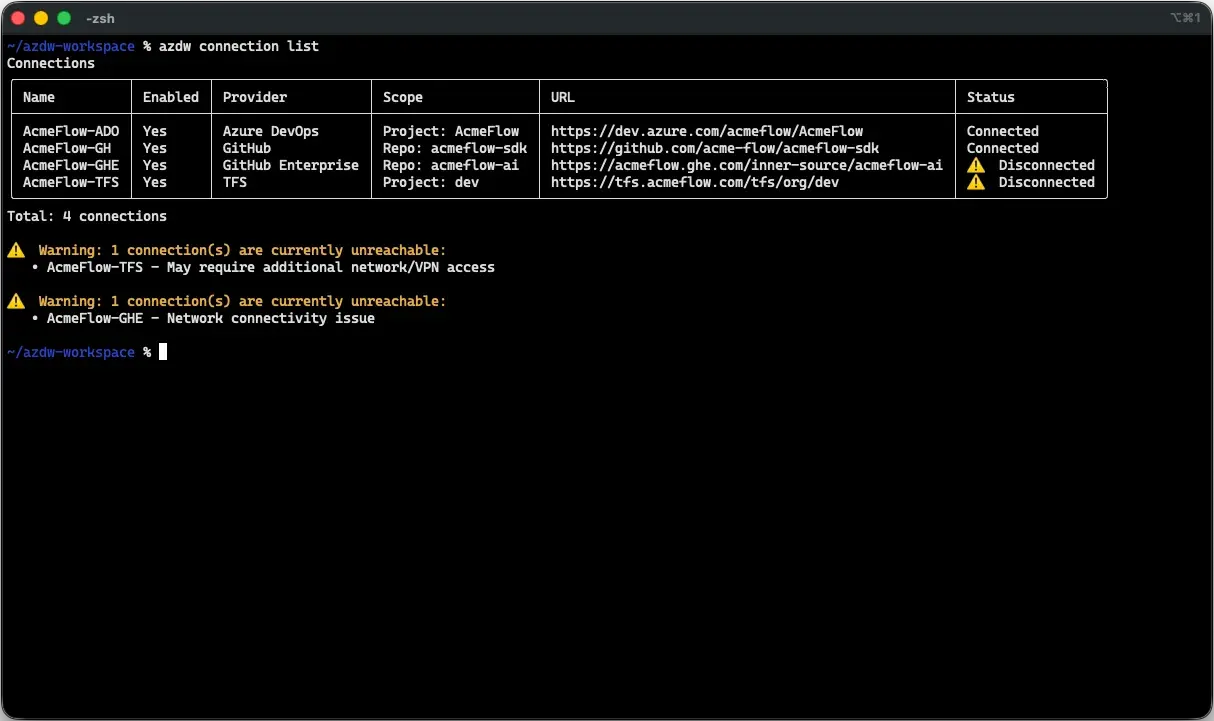
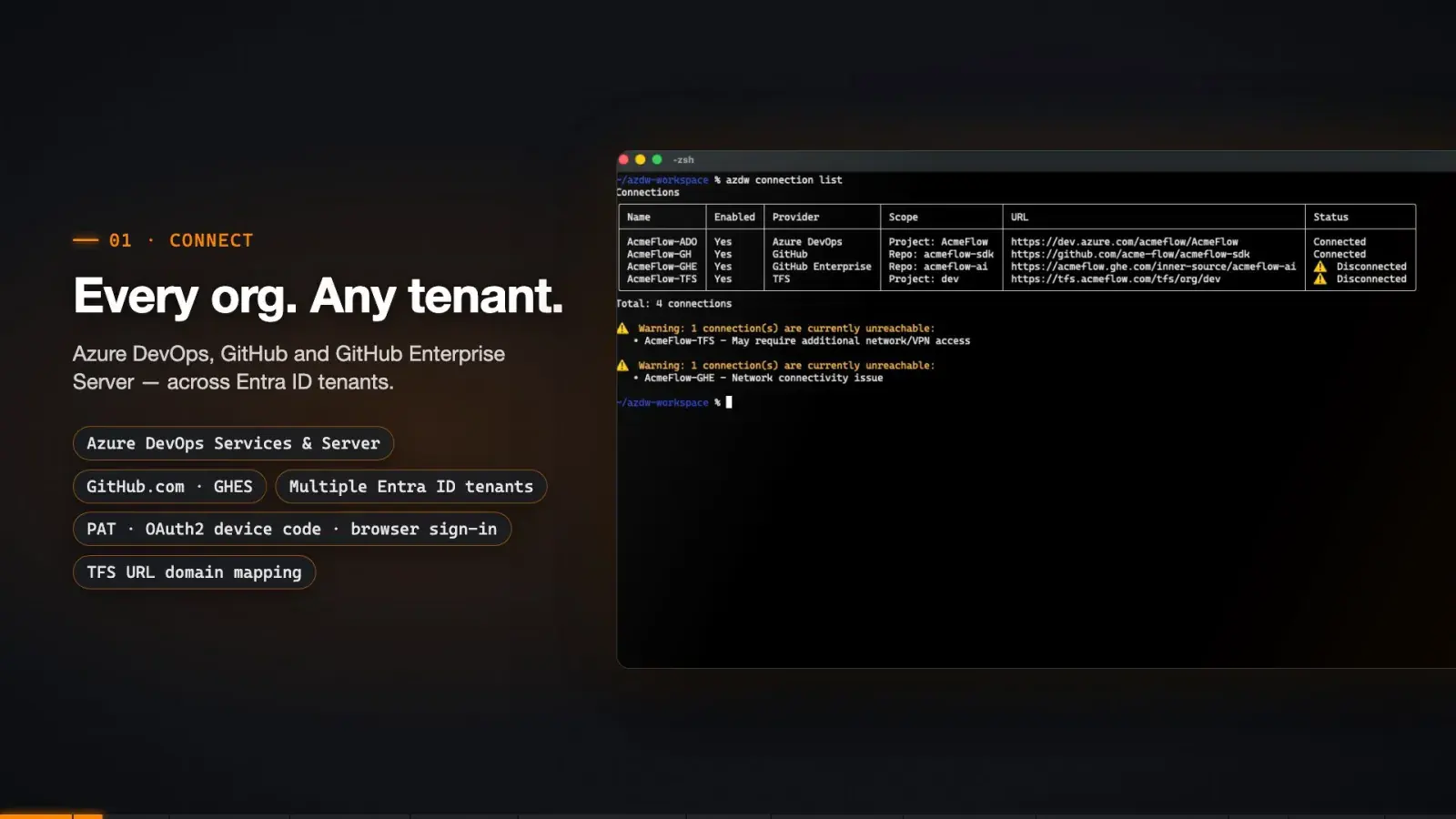
Azure DevOps Services and Server, GitHub.com and GitHub Enterprise Server — across Entra ID tenants. PAT, OAuth2 device code, or browser sign-in.
azdw connection add --name CT --url https://dev.azure.com/…
Portfolio intelligence across every org, tenant, and project — governed, and fully local if you need it.
30-day free evaluation.NET 10 LTSLinux · Windows · macOS
Real product output. Nothing here is a mock-up.
Work that belongs together rarely lives together. Four forces split it across Azure DevOps organizations, Entra ID tenants, and GitHub:
Acquired teams bring their own orgs and tenants.
Azure DevOps org/project ceilings split growing estates.
Regulated units get their own tenant on purpose.
“It was set up that way in 2016.”
The portfolio exists. Nobody can see it in one place.
Microsoft documents the manual Power BI cross-organization path — it works, and it takes weeks. Read the devblog ↗

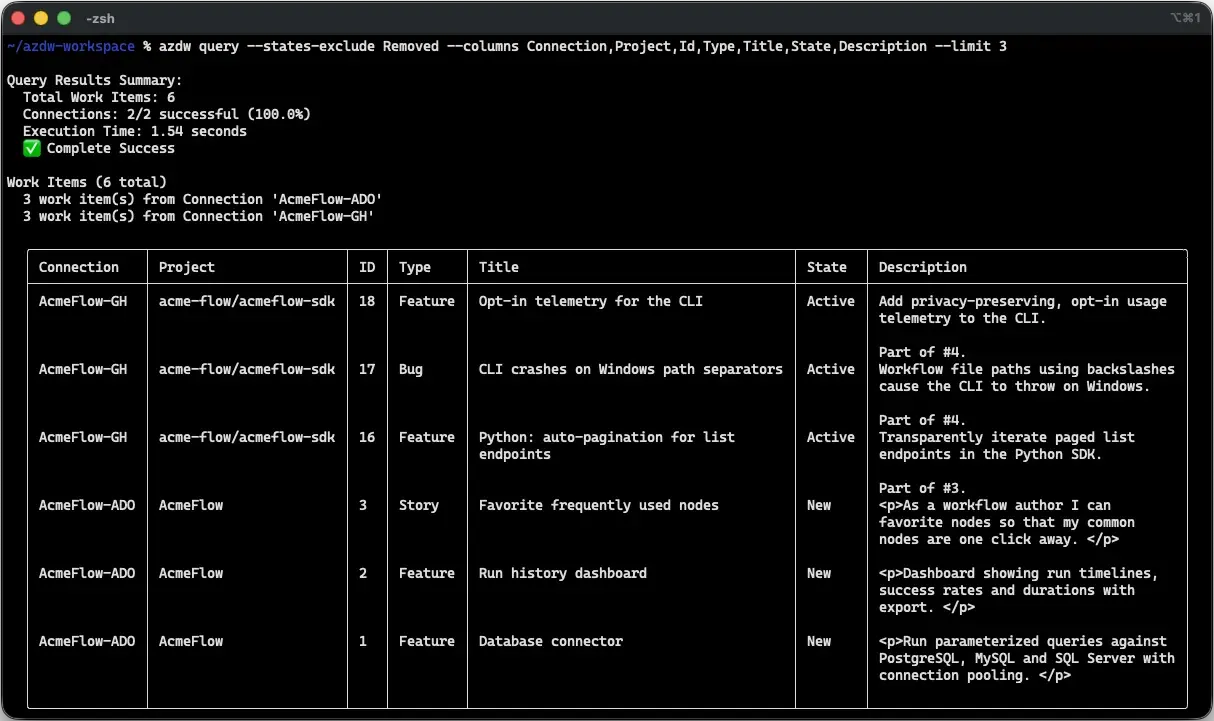
azdw query --columns Connection,Project,Id,Type,Title,State — two providers, one table.
Three steps, no BI project, no data warehouse. Every step is a command you can commit and re-run.

Azure DevOps Services and Server, GitHub.com and GitHub Enterprise Server — across Entra ID tenants. PAT, OAuth2 device code, or browser sign-in.
azdw connection add --name CT --url https://dev.azure.com/…

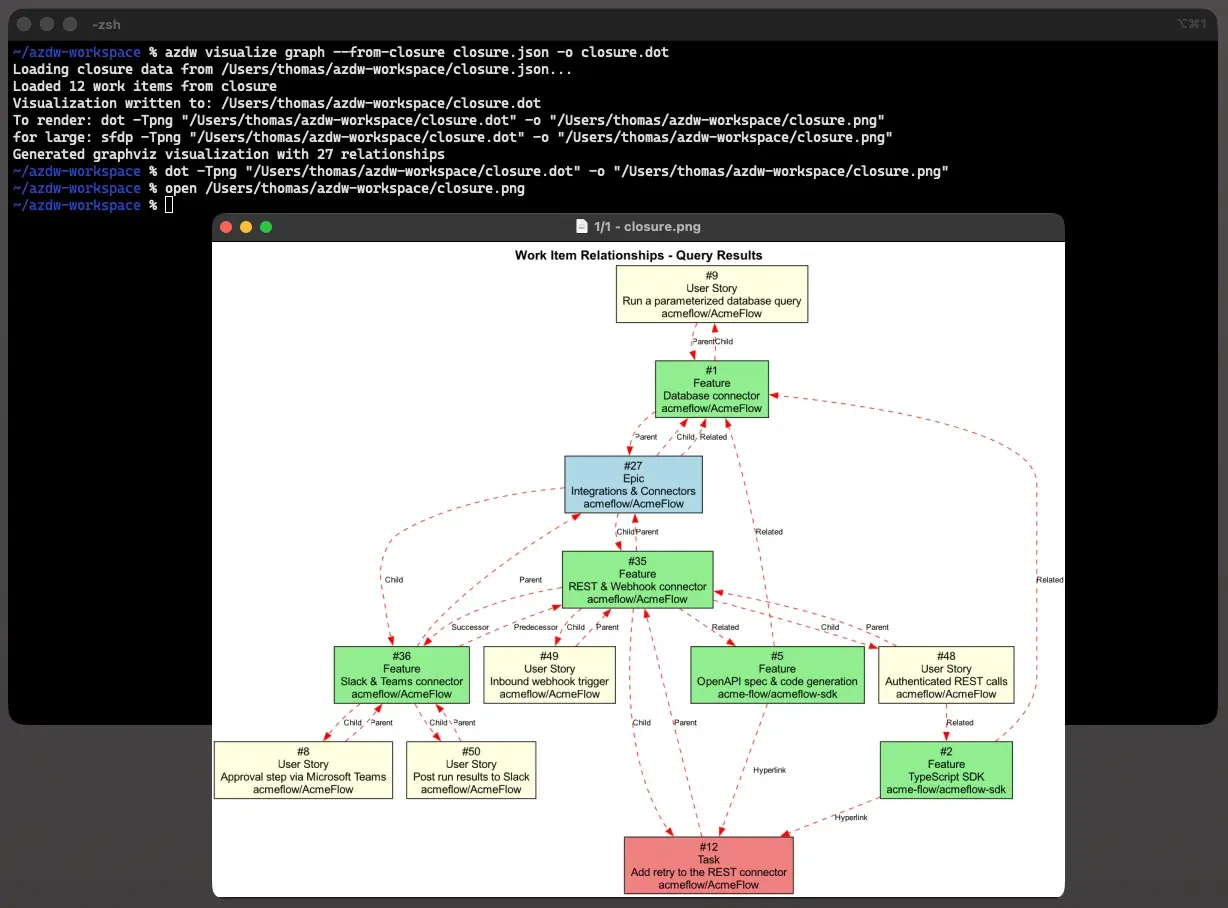
Hierarchy, dependencies, and hyperlinks — including links pointing back in from another org — resolved into a queryable closure.
azdw relationship find-closure --ids 9 --top-type Epic

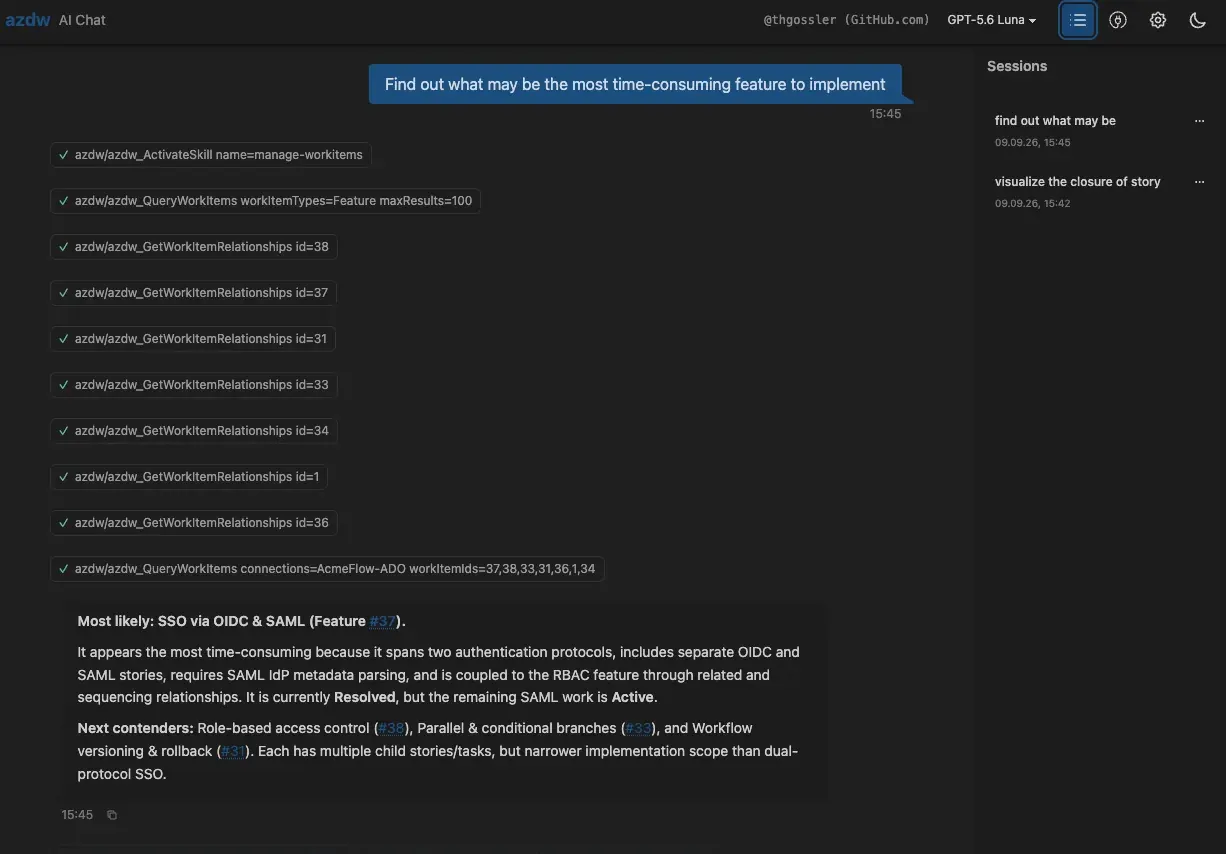
Tables, reports, and graphs without a model; plain-language answers with one. Zero-setup Web UI for leaders, CLI and MCP for engineers and agents.
azdw ai-chat --webui
The deterministic data layer works without AI. If you opt in, you choose the provider and model and can change them later without changing your collection and query scripts.
No model anywhere. Query, resolve, report, visualize — interactively or headless, with guaranteed --json and exit codes. Drop it into a pipeline and run it on a schedule.
azdw query --connections A,B,C --json \ | jq '.[] | select(.State=="Active")'
Add value where it counts: plain language to WIQL with --ai, closure narratives with --ai-tell-story, AI-assessed reconciliation, terminal chat and the Web UI.
azdw query --ai "high-risk items not \ assigned to a release"
Keep model processing local: run the model on your own hardware with Ollama or another local OpenAI-compatible endpoint. Work-item content stays in your infrastructure when every model and agent endpoint in the workflow is local.
azdw config ai set --approach ollama \ --model gemma4:12b
Already paying for Copilot? Use it as azdw's AI provider — no extra API key, no new vendor. Anthropic, OpenAI and Azure endpoints work too.
azdw config ai set \ --approach github-copilot
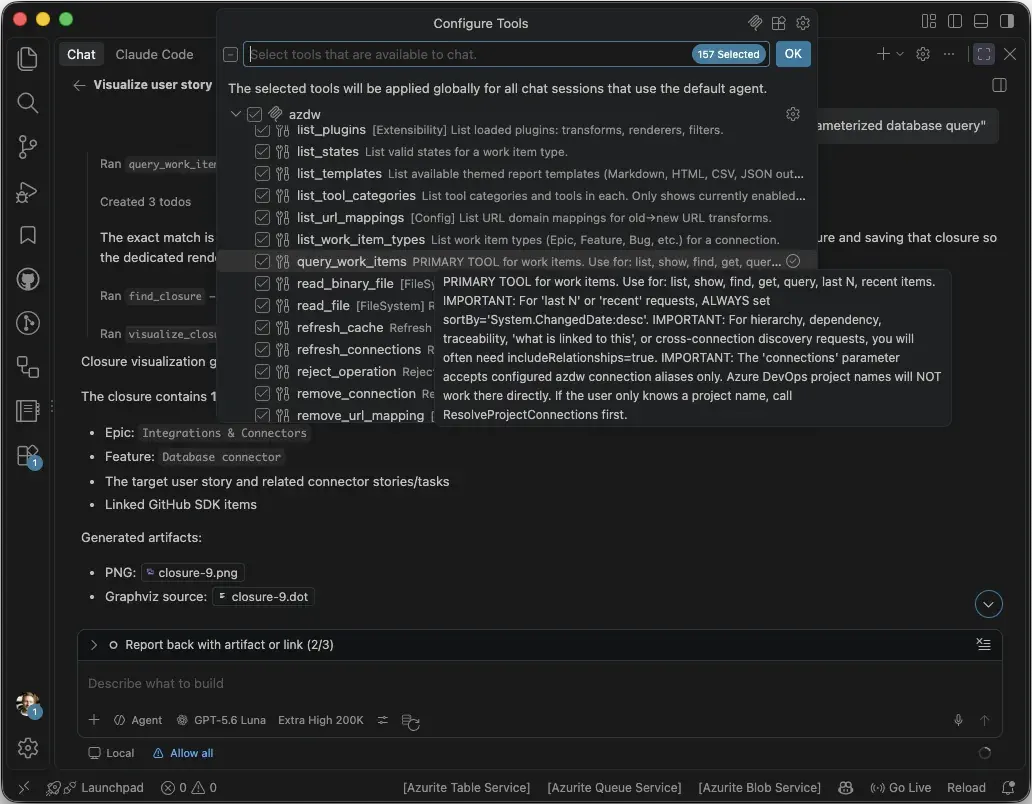
Let the agent do the tool calling. VS Code Copilot, Claude Code or Claude Desktop get a pre-shaped, deterministic view of your work items — with two-phase approvals on every write.
azdw mcp azdw config ai skills install
AI is optional. Its output comes from the provider and model you configure and varies with your data, prompts, permissions, settings, and instruction or skill files such as AGENTS.md. Review outputs and every proposed change before relying on or approving them; do not use AI output as the sole basis for decisions with legal or similarly significant effects on a person. See the AI terms and permitted-use conditions.
Your portfolio doesn't stop at a tenant boundary. Neither does azdw.
Multiple Entra ID tenants, orgs, projects, process templates — one integrated result set with Organization/Project columns.
AI tokens are spent on thinking, never on fetching.
Deterministic collection spends 0 tokens; the model gets one pre-resolved, pre-shaped payload — no chatty API crawl flooding the context window.
Regulated data stays in the building.
Two-phase write approvals (preflight → confirm) for humans and agents alike.
First cross-company report before the coffee is cold.
Install → connection add → query. No BI build, no export pipeline.
Every number in the board deck has a command behind it.
Every answer is a re-runnable, version-controllable command with guaranteed --json output.
Leaders use the zero-setup web chat. Engineers use the CLI. Agents use MCP. Same data, same rules.
CLI · Web UI · MCP · VS Code Copilot · Claude Code · PowerShell · .NET library · REST/GraphQL.
azdw reconcileRead-only analysis across all your connections: duplicate and related candidates, consolidation proposals, missing Related-link proposals, and explicit clusters — across Azure DevOps, GitHub and GitHub Enterprise Server.
AnalyzeWorkItems, via REST and GraphQL, and as a graph export (GraphML / D3 JSON).azdw reconcile --types Epic,Feature --states-exclude Removed --max-items 100 --output analysis.json azdw report generate --template-id work-item-analysis-html --data analysis.json --output review.html
New on this page only — the videos and screenshots above predate it.
Connections, cross-tenant queries, relationship graphs, reports, the Web UI chat, governed writes, local AI, and the MCP server inside VS Code and Claude Code.
--connections flag; Agile, Scrum, and CMMI field names abstracted so one script works everywhere.report generate command, Markdown or HTML, re-runnable next month.azdw reconcile: candidates, consolidation and missing-link proposals, offline review report.| Microsoft tool | What it handles | What azdw adds |
|---|---|---|
| ADO Remote MCP server | Live single-org operations, official API parity | Cross-org / cross-tenant, GitHub, deterministic pre-shaped context, local AI |
| Git DevOps Assistant | In-editor single-org developer workflow (@devops) | Portfolio layer, work-item graph, governed reporting |
| GitHub Copilot | Your agent harness | azdw is one of its tools — and can use your Copilot subscription as its AI provider |

azdw MCP registered side-by-side in VS Code. They handle single-org depth; azdw adds the cross-tenant portfolio layer.
“Company X” develops medical imaging software under IEC 62304. Platform and CT modality work live in two Azure DevOps orgs in Tenant A; Central IT runs in a third org in Tenant B for historic, security, and regulatory reasons — plus GitHub Enterprise Server for open-source-derived components.
Before: three per-org exports merged by hand every quarter, a Power BI attempt that could not see the second tenant, and one regulatory-tagged item found by an auditor instead of the team.
Sign out, sign in, wrong browser profile, which org was it again, why are their fields named differently. azdw fixes the boring part: connect each client's org once — different tenants, GitHub too — and query one or all of them.
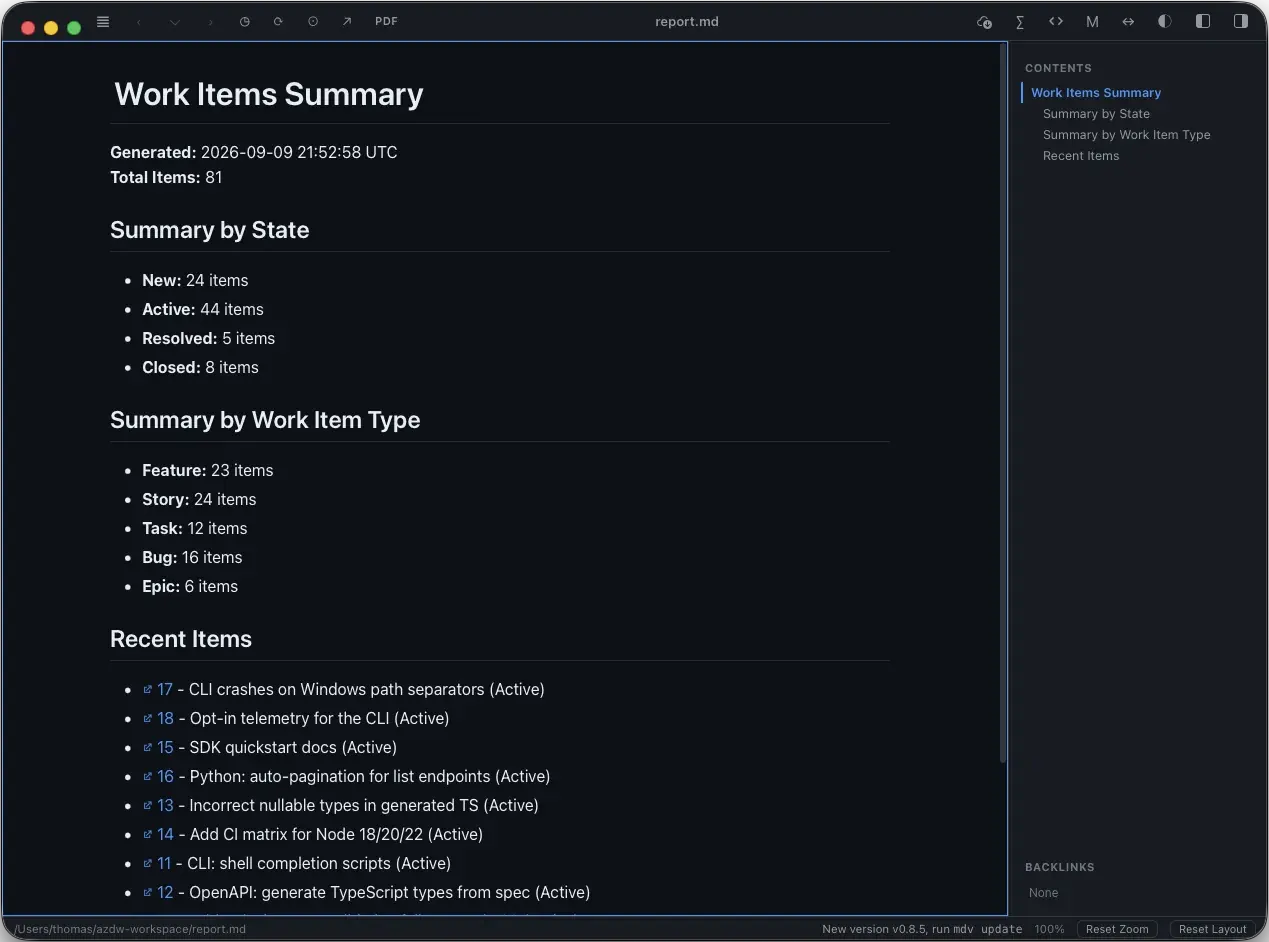
azdw report generate to Markdown or HTML, re-run next month.
A report generated from one command, ready to send.
“Claude Code, but for work-item & portfolio management instead of coding.”
Terminal-native, agentic, skills and MCP built in — pointed at your backlog instead of your repo. And useful with or without a model.
“The USB-C of work-item data.”
One self-describing CLI with guaranteed --json output. Plugs into shell, CI, PowerShell, MCP, REST/GraphQL, .NET — same shape regardless of org, tenant, or process template.
“Power BI cross-org reporting — but as a live, re-runnable query.”
No per-org datasets to stitch and refresh. One command, any format, cross-org relationships included — and Power BI can still consume the CSV if you want the dashboards.

Often under €1. Licensed per organization, not per seat — every employee can use it, whether ten people or ten thousand do.
≈ €42 / month · unlimited client orgs · independent consultants and micro-consultancies
Buy via PaddleFrom €2.67 / employee / month at 250 employees
Buy via Paddle€0.56 / employee / month at 3,000 employees · Managed / BYOC add-on available
Contact for a quotePurchasing opens with the public release. Join the wait list and we'll tell you the day it does.
“Organization size” is the total number of people employed or contracted by the licensing entity, regardless of how many use the software. Per-employee figures are the annual price divided by that headcount; Enterprise is quoted from €19,999 depending on scale.
One e-mail when the public release is out — where to get it and what it costs. No newsletter, no sharing, and your address is deleted right after that e-mail.
Good — keep it. It gives your agents live single-org depth with official parity. It stops at the org/tenant boundary and does not know GitHub. Add azdw MCP alongside it in the same VS Code or Claude Code session; the moment a question spans two orgs or tenants, azdw answers it.
It's a strong in-editor developer workflow tool — sprint dashboards, PR drafting, pipeline triage — scoped to one org/project at a time. Portfolio questions, cross-tenant traceability graphs, governed reporting, and local AI are outside its scope. Both MCP servers run side-by-side.
azdw is useful without AI. If local AI is permitted, configure only local model and agent endpoints so work-item content stays in your infrastructure. Writes go through a two-phase preflight → confirm approval, and every answer can be traced back to a re-runnable data-collection command.
You choose and configure the AI provider, model, data, permissions, prompts, and instruction or skill files. Their terms apply, and their output can be inaccurate, incomplete or biased. You must review the output and every proposed change before relying on or approving it. azdw is not intended to make employment or other legally significant decisions about people. See the AI terms and permitted-use conditions.
Keep it for dashboards. The cross-org path is a manual, per-org Analytics/OData build that Microsoft documents themselves: weeks to stand up, maintained separately, no cross-org relationships, not re-runnable from a shell or an agent. azdw is minutes, live, re-runnable — and can feed Power BI via --format csv.
Yes — github.com and GitHub Enterprise Server. Issues are first-class work items with the same query, relationship, CRUD, visualization, and reporting commands. Labels, types, and states are projected into the unified model; Azure DevOps-only capabilities degrade gracefully.
It is — if the LLM does the fetching. azdw collects deterministically for zero tokens and hands the model one pre-shaped payload. Tokens are spent on reasoning only, and the same input yields the same collection every run.
Healthcare is where we started because it has the strictest version of the problem: regulated separation, multiple tenants, traceability duties. The root causes — M&A, scale limits, compliance separation, history — are industry-agnostic. If you have more than one Azure DevOps org, you have the problem; with two tenants, you have it badly.
You can — for one org, one process template, one weekend. Then the second org uses Scrum instead of Agile, the third is in another tenant and auth breaks, the fourth is GitHub. azdw already abstracts process templates, resolves cross-tenant auth, handles partial success and rate limits, and keeps improving. One engineer-month of homegrown pipeline costs more than a year of azdw.
Because the name is a ladder, and we just added a rung:
Four letters, and the last one is a “double-u” — three syllables for a single letter, which is a lot to ask of anyone before coffee. So we say A-Z-D-U: the “D-U” does the job of D and W together. Not important. But now you know.
Mnemonic for the rock fans: think AC/DC, say AZ/DU. Same energy, fewer amps, no work item left behind. 🤘
Thirty-day evaluation, binary install, first cross-org query in minutes. If you have more than one org or more than one tenant, you already have the problem — see it in your own data.